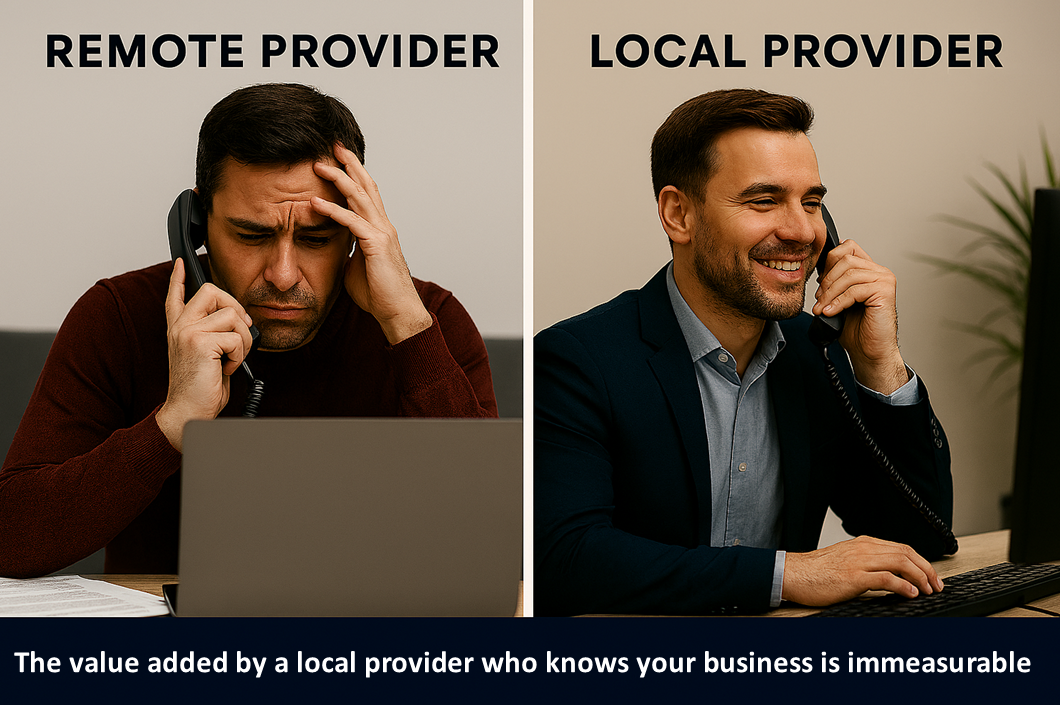
Why Choosing Local Telecoms Providers Beat the Cheapest Online Deal Never has it been easier…
Your Guide to Business Broadband Terms & Jargon
Business broadband is full of technical terms that can make it harder to compare your options and make decisions about the right service and provider for you.
Too often the acronyms can hide what really matters to your business which is speed, reliability, cost and flexibility.
We have broken down the most common business broadband terms and jargon.
FTTC (Fibre to the Cabinet): is where there is Fibre to the local cabinet but then the last part of the cabling is copper from the nearest cabinet to your property. Watch out for providers advertising “fibre” when it’s only FTTC.
This is a legacy service and is built on top of a telephone line. Your current supplier should be proactively moving you away from this product.
SoGEA ( Single Order Generic Ethernet Access)
This is a broadband-only service that does not require a phone line.
It is the most common type of broadband for businesses, particularly those in areas that have not been upgraded to full fibre. It is the replacement for FTTC services that run over copper cables.
FTTP (Fibre to the Premise) is where your business has fibre broadband directly to your premises, making it faster and more reliable than SoGEA connections. Broadband running over fibre lines is up to 12.5 times faster than SoGEA.
Leased Line – A dedicated fibre connection just for your business offering guaranteed speeds, ideal for large teams or high data usage.
Contention Ratio: How many users share the same bandwidth. Lower = better.
Upload vs Download Speeds
Download = receiving data (web browsing, streaming).
Upload = sending data (video calls, cloud backups).
Businesses often need balanced performance for both particularly if making a large number of calls or consuming cloud-based services where they upload large files.
Latency: The time it takes data to travel. Low latency = better performance for video calls, VoIP, and cloud tools.
Symmetrical Speeds: Equal upload and download speeds. Critical for remote teams, file sharing, and real-time tools, that work alongside high data connectivity services. Leased lines operate with symmetrical upload and download speed.
5G / LTE (4G) Failover: Mobile broadband services are typically used as a backup connection if your main broadband fails. However, in some locations this broadband technology may give you the best connectivity option for your business.
Static IP: A fixed internet address for your connection. Needed for remote access, VPNs, hosted servers, and beneficial for operating reliable VoIP solutions.
SLA (Service Level Agreement): A guarantee of uptime and response times from your broadband provider that sets expectations for how quickly faults are fixed.
Line Rental: A separate charge for the old phone lines, now often unnecessary when modern services like SoGEA are deployed.
All-IP / The Big Switch Off: All phone lines will move to internet-based services (IP). With the legacy phone networks being turned off in 2027 broadband is becoming the primary service every customer needs. Telephone services are migrating in their entirety to VoIP.
Final Word
Broadband doesn’t need to be confusing. At Peterborough Telecom, we keep things simple. We believe in clear pricing, no unnecessary extras, and jargon-free advice.
Need help making sense of your current setup?
Get in touch and speak to a real person who’ll actually explain your options.
Related Posts